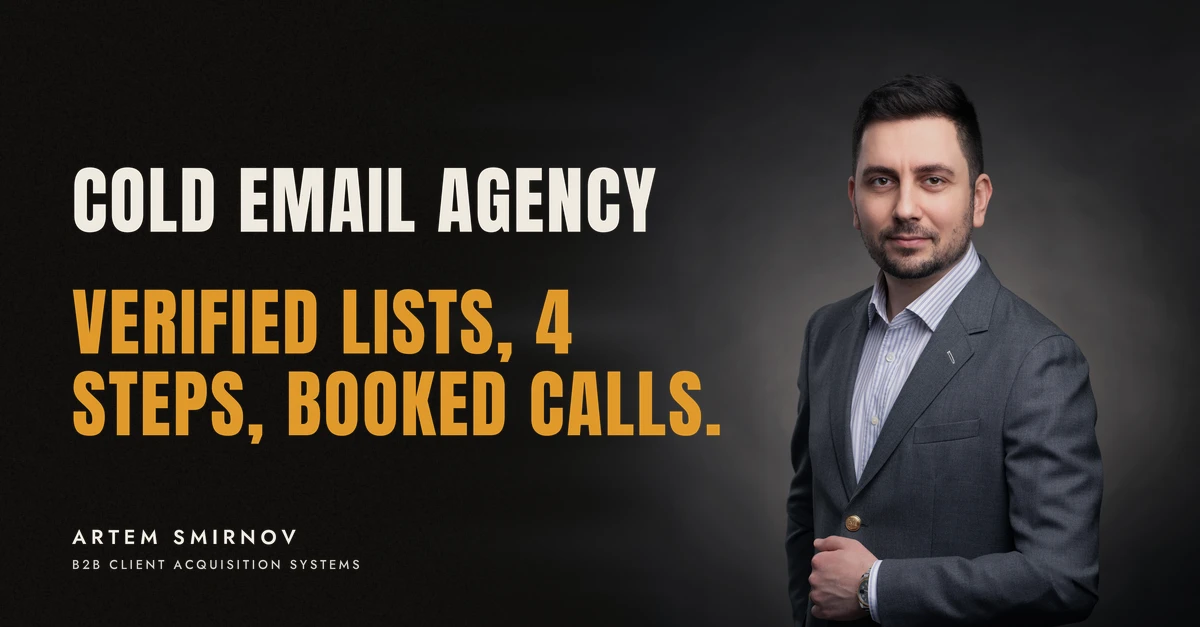
Cold email for B2B companies: Smirnov Consulting Group runs cold email campaigns from separate sending domains, list building and verification, qualification and booking, launching about 15 days after the contract is signed.
Smirnov Consulting Group is a Prague-based B2B outbound lead generation agency that runs cold email and LinkedIn campaigns for B2B companies and books qualified sales calls. 12 years in outbound, 500+ B2B companies, 24 countries.
The short version: channels, rules, reporting and terms
- Channels: cold email from 10 to 20 separate domains and 20 to 40 mailboxes, never your main domain. Most campaigns open on LinkedIn with warm email follow-ups, and cold email volume goes on top after the first two or three weeks. When LinkedIn cannot reach enough people, cold email becomes the main channel.
- Who we contact: the people who can sign at your target companies. Usually founders, owners, CTOs, VPs of Sales or CMOs, depending on what you sell.
- Qualification rule: agreed with you before launch. A prospect has to match the company and title profile we set together before a call is booked.
- Reporting: people contacted, replies, calls booked, calls that actually happened and deals signed, as separate numbers, including the ones that look bad. A weekly report, a monthly report and live notifications every day, plus a client portal with live campaign data if you want one.
- Launch: about 15 days from signed contract. Domain setup and 10 to 14 days of mailbox warm-up run inside that window, and first replies and booked calls often come within the first 30 days after launch.
- Terms: from USD 3,000 (about EUR 2,500) per month, depending on scope. Sending domains, mailboxes, data and tools are paid by you directly and scoped per client. No minimum contract length, 1 month's notice, at least 3 months recommended. Details on the pricing page.
- Who does the work: senior experts only, no interns and no juniors: lead generation experts, GTM architects, GTM engineers who build the lists and sending infrastructure, and AI specialists. A senior team member runs your account day to day, and you have a direct line to Artem Smirnov, the founder. We keep the client list small on purpose, so every client gets full attention and full responsibility for results. Before you sign with any agency, ask who exactly will write and send your cold emails, then look them up on LinkedIn. You can look up ours.
- Ways to work: done-for-you, where our team runs everything. Or 1-on-1 consulting and group coaching, where your team runs it and we show them how.
Your main domain never sends a cold email
Cold campaigns go out from separate domains: close variants of your brand that point to a real page. If your main domain gets flagged, your invoices, support replies and contracts start landing in spam next to your outreach. Our deliverability guides cover the setup in detail.
Before any send, every domain gets SPF, DKIM and DMARC records. They tell receiving servers the mail is really yours.
Every client and every campaign sends from dedicated IP addresses, separated even across different domains, not just across clients. One client can run on 10 to 20 different sending IPs, so a problem on one never spreads to the rest.
Then each new mailbox warms up for 10 to 14 days, sending small volumes to real inboxes until it looks like an account a person uses. Ten days is our minimum. For one software development client in Germany, the setup was 10 domains with 20 email accounts on top, for a single team.
Volume comes from more mailboxes, not harder ones
We plan around 25 emails per mailbox per day. In one real month for that German client, 5,000 people were contacted by cold email: 15,000 emails across the sequence, from 20 addresses.
Compare the usual do-it-yourself setup: two mailboxes and a thousand sends a day. That burns the domains fast.
The math also runs backwards from your goal. For 30 to 35 sales calls a month, you contact at least 10,000 people, and the setup has to reach about 1,000 people a day. For one tech startup in the UAE, LinkedIn could not scale, so cold email became the main channel: 50 email accounts, roughly 1,250 emails a day.
When a sequence works, we scale sideways. More mailboxes run the winning sequence, and no single inbox gets pushed past its limit.
The list decides more than the copy
Almost every failed campaign we get asked to rescue failed in two places: the list and the foundations. So the list comes before a word of copy.
We build it with 16+ B2B data tools, including Sales Navigator, Apollo, ZoomInfo and Clay. Then we clean it:
- Titles cut down to people who can sign. "Assistant" and "Associate" go on purpose.
- One headcount range you actually serve, not 1 to 10,000 employees.
- Specific countries, split between reps so two people never email the same prospect.
- Every address verified with NeverBounce, or DeBounce as a second option. Bounce rate stays below 0.5%.
The first list usually starts at 20,000 contacts or more. A buyer who is busy this quarter is a timing problem, and only a big enough list absorbs it.
Four emails, and each one has a job
Cold email gets four steps. You have less permission than on LinkedIn, so every step has to earn its place: a new angle, a different pain, a piece of proof, a short question. A "just checking in" email gets cut before launch.
Every email sells the meeting, never the whole service. Twenty minutes on Zoom is a small enough ask for a stranger. A contract is too big.
We leave real time between steps. In our campaigns, the third follow-up is usually what works best, and most teams give up before they send it. Each step also runs in several variants, so ten thousand people do not receive the exact same text.
Replies go to a person, and calls go to your calendar
A human inbox manager reads every reply. Interested prospects are qualified and booked into your calendar, and your team takes the sales call. Details on our appointment setting page.
Case: US B2B company, 141 sales calls in 60 days
A B2B company in the US came to us after hiring 3 agencies. They overpromised and under-delivered, and the team had concluded that cold email did not work in their niche. The founder was about to move the budget into ads, which were not returning a positive ROI either.
We rebuilt it from the bottom, in order:
- Offer, positioning and ideal client profile: one clear promise to one clear type of buyer.
- The website home page, and the founder's and sales team's LinkedIn profiles.
- Custom lists of decision-makers who matched the profile, instead of random scraped data.
- New sequences: new angles, new subject lines, new follow-ups, short human emails.
- Proper sending infrastructure.
Over 60 days we emailed 70,000+ people with clean data and low bounce rates. Result: 335 interested leads and 141 sales calls booked in 60 days.
You might not need 141 calls in 60 days. It is a big number, and most teams cannot staff it. The same process works for 5 to 10 good clients a month, with a smaller list. Full story: US B2B company, 141 calls in 60 days.
Not a fit if
- You want cold email sent from your main company domain.
- You need emails going out next Monday. Warm-up alone takes 10 to 14 days.
- Nobody has bought your offer yet at your current price. We are in the lead generation space, not the building-businesses-from-zero space.
- You would pause the campaign when things get busy. Paused mailboxes lose their warmth, and lists go stale.
Questions buyers ask about cold email
Will cold email hurt our main company domain's reputation?
No, because your main domain never sends it. We buy separate domains, close variants of your brand, and run every campaign from mailboxes on those. If one of them picks up a bad reputation, your invoices, contracts and support emails keep reaching inboxes as before.
How do you make sure cold emails reach the inbox and not spam?
We do the work before the first send. SPF, DKIM and DMARC go on every domain. Each mailbox warms up for 10 to 14 days, then sends about 25 emails a day, not hundreds. Every address is verified, so bounces stay below 0.5%. And each step runs in variants, so the same text is not sent ten thousand times. Skip one of these and the others stop working.
How long before a brand new domain is ready to send cold email?
Ten to fourteen days of warm-up after the authentication records are in place, and ten days at the very least. The records themselves are about an hour of DNS work. The full setup, with lists and copy, takes about 15 days from signed contract to launch, with the warm-up running inside that window.
How many cold emails can one inbox send per day?
We plan around 25 per mailbox per day. That is why a serious campaign runs on 20 to 40 mailboxes across 10 to 20 domains. Volume comes from the number of mailboxes, never from pushing one harder. During its 10 to 14 days of warm-up, a new mailbox sends far less, mostly to real inboxes that reply.
How many follow-up emails do you send per prospect?
Four emails in total: the first message and three follow-ups, with real time between them. In our campaigns, the third follow-up is usually the one that works best. Each step brings something new: an angle, a pain, a proof point or a short question. When the prospect first met you on LinkedIn, the warm email sequence runs longer, 7 steps across both channels.
Why do most cold email campaigns fail?
Most fail in the setup, before the copy gets a chance. What we see most often: sending from the main domain, missing authentication records, no warm-up or three impatient days of it, one mailbox doing the work of twenty, unverified lists bouncing, and the same text sent ten thousand times. The quiet one is volume: a setup built for a hundred people a month when the goal needs ten thousand.
Related
- Pricing
- Case studies
- LinkedIn outreach agency
- Appointment setting
- Industries we run cold email for: construction companies, civil engineering companies, industrial and manufacturing companies, SaaS and tech startups, software development companies, IT services and consulting, SEO agencies
- Deliverability and infrastructure FAQ
- Lists and targeting FAQ