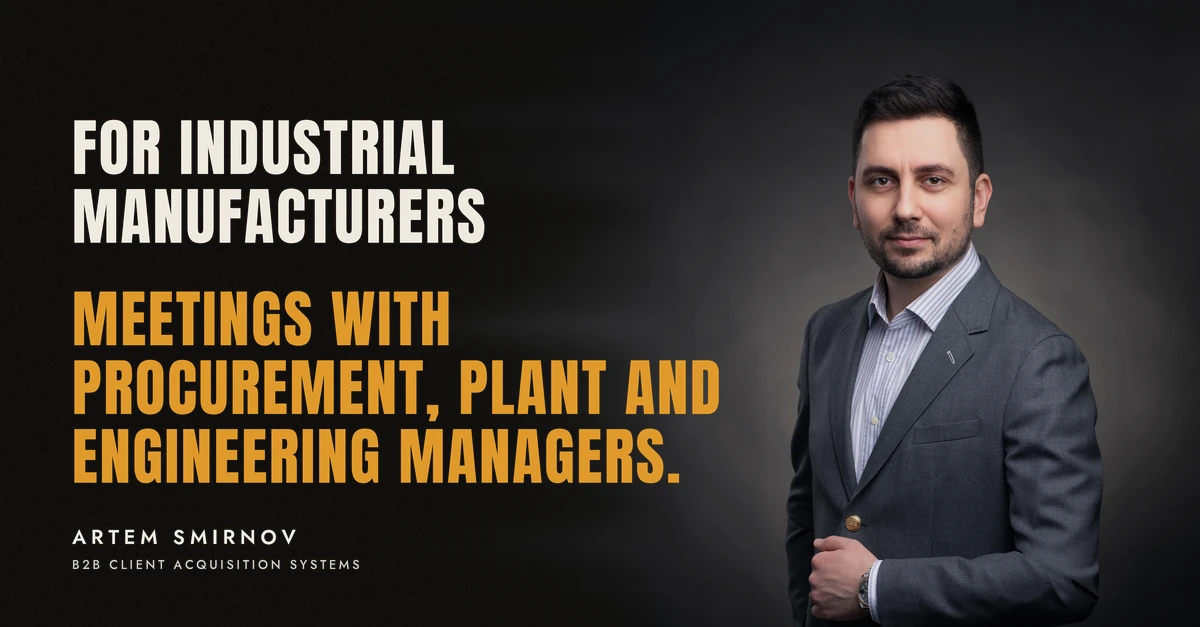
Smirnov Consulting Group books qualified meetings with procurement managers, plant and operations managers, engineering managers, health and safety leads and distributors for industrial manufacturers, industrial equipment makers and B2B suppliers, using LinkedIn and cold email. Our clients sell into the US, the UK and international markets, and they want buyers they would never meet at a trade show.
- UK manufacturer of fall-protection equipment for construction sites: 200+ sales calls and 600+ leads over 2 years, from 24 countries.
- Replies from industrial, energy, engineering and construction companies such as AECOM, bp, Skanska, Doka, Altrad and Saipem.
Smirnov Consulting Group is a Prague-based B2B outbound lead generation agency that runs cold email and LinkedIn campaigns for B2B companies and books qualified sales calls. 12 years in outbound, 500+ B2B companies, 24 countries.
Who is this for?
Industrial and manufacturing companies that sell to other businesses, have a product a buyer can check, and want more of the right buyers in more countries. Usually the company is privately held or family-owned, the product is good, and most new business still comes from referrals, distributors and one or two trade shows a year.
The companies we see most:
- Industrial manufacturers that make products for other industries: construction, energy, oil and gas, utilities, logistics, food and process plants
- Industrial equipment makers: machinery, access and safety equipment, handling and lifting equipment, tooling, temporary structures
- Component and materials suppliers that sell to OEMs and need a second or third route to new accounts
- Contract manufacturers, fabricators and machine shops that want new programs from larger manufacturers
- Suppliers based in the UK or Europe selling B2B into the US, and US suppliers expanding abroad
The people who hire us:
- The owner or managing director, who still closes the biggest accounts personally
- The sales director or commercial director
- The export manager or head of international sales, at companies opening new countries
The people we book into your calendar:
- Procurement managers, buyers, category managers and supply chain directors
- Plant managers, operations directors and production managers
- Engineering managers and design engineers who write the specification
- Maintenance managers, for spares, consumables and equipment that keeps a line running
- Health and safety managers and HSE directors, when the product protects people
- Project directors at contractors and EPC companies that buy equipment for sites
- Distributors, dealers and resellers, when you want a partner in a new country
Why is outbound hard for manufacturers?
The buyer is on the plant floor or on site. A plant manager or a project director is not reading long emails at a desk. Our industrial articles map the buyers sector by sector. A message that names one problem on their type of line or site gets read. A company brochure does not.
Several people decide. The engineer specifies, operations uses it, procurement negotiates and a director signs. One contact per company is not enough, so we reach several roles at each target company.
Buying runs through approved supplier lists. Many industrial buyers only order from suppliers who have passed their qualification. The first goal of outbound is often to get onto that list before the next order, not to sell on the first call.
Sales cycles are long. A buyer may like your product today and order it for a project or a budget that starts next year. In industrial B2B that is normal, and it is why outbound here is judged over quarters, not weeks.
Trade shows and distributors only reach part of the market. A stand meets whoever walks past. A distributor sells your product next to fifty others. Outbound reaches the exact companies and roles you choose, in every country you sell into, every month of the year. We compare the routes in detail in outbound for manufacturers vs trade shows.
Why LinkedIn and cold email work for industrial companies
Procurement heads, engineering managers and operations directors are on LinkedIn. Before they reply to a stranger, they look up the sender. That is why the campaign runs from the profiles of your founder or sales team, and why those profiles get rebuilt first.
Cold email reaches the same people in their work inbox, where supplier questions and quote requests already arrive. Running both from real people at your company means a buyer sees your name twice, in two channels, instead of ten times in one.
How do we run outbound for a manufacturer?
1. One product, one buyer segment, one market. We start with one thing you sell and one type of buyer who needs it, for example edge protection for main contractors in the UK, or handling equipment for food plants in the US. "We make everything for every industry" gives a buyer nothing to answer.
2. Proof before volume. Before anything goes out, we look at your company the way a buyer's procurement team would: your website, your LinkedIn profiles, product data sheets, certifications and approvals, and reference projects. A short video of the product in use often does more than a catalog. If the proof is missing, we build it with you first.
3. Lists built on company fit. We build lists from 16+ B2B data tools, including Sales Navigator, Apollo, ZoomInfo and Clay. Then we check each target company against what it actually does, from its own website, so "manufacturing companies" becomes the plants and contractors that use your kind of product. We add several decision makers per company and verify every email, so bounces stay under half a percent.
4. LinkedIn and cold email, sent from real people. LinkedIn outreach runs from your team's profiles, with warm email follow-ups. Separate cold email campaigns run from dedicated domains we set up and monitor, on dedicated sending IP addresses. We handle SPF, DKIM and DMARC, warmup and monitoring. When a prospect replies in one channel, we stop the other one for that person. No paid ads.
5. Qualified calls on your calendar. We answer the replies and check each prospect against the criteria we agree with you: the type of company, the region, the application and the timing. Then we book the call with you or your sales team.
Compliance. Most of our campaigns target the USA, the UK and English-speaking Europe: CAN-SPAM applies to US buyers, UK GDPR and PECR to UK buyers, and CASL to Canadian ones. Business contacts only, a simple way to opt out in every email, and anyone who asks to stop is removed and not re-added. Your current customers, distributors and anyone you name are excluded before launch. In Germany, Austria and the Czech Republic, where business email needs prior consent, we do not send cold email without a compliant basis and use LinkedIn instead. This is how we work, not legal advice.
Case: UK manufacturer of fall-protection equipment, 200+ sales calls over 2 years
A UK manufacturer of fall-protection equipment for construction sites. Its products protect people working at height and catch falling debris on construction, industrial and energy sites.
What we did:
- Chose the buyer segments where the product solves a daily problem: main contractors, scaffolding and access contractors, and industrial and energy contractors
- Built target lists company by company, checking each company's own website
- Reached several decision makers per company: project directors, operations and engineering managers, procurement, and health and safety leads
- Ran LinkedIn outreach and cold email side by side, and paused LinkedIn for anyone who had already replied by email
- Kept the lists fresh for 2 years, adding new countries and segments as the old ones were worked through
| Result over 2 years | Number |
|---|---|
| Leads | 600+ |
| Sales calls | 200+ |
| Countries the leads came from | 24 |
Replies came from companies such as AECOM, bp, Skanska, Doka, Altrad and Saipem, names a small manufacturer rarely reaches through referrals and distributors alone.
What it shows: for an industrial product, outbound is a long game. The calls start supplier relationships, and orders follow project and budget timing. Full story: UK fall-protection manufacturer, 200+ sales calls.
How long does it take, and what does it cost?
- About 15 days from signed contract to launch. Onboarding starts in the first week, usually one 60-minute call plus a few emails.
- First 30 days live: the first replies and booked calls.
- After that: once a message and a list work, we add countries, buyer segments and sending capacity.
Industrial deals are slow. B2B sales cycles often run 6, 9 or 12 months, so a call booked in the first 30 days may become an order four months later or more. Judge the first month on conversations, not on orders. We recommend at least 3 months, and about 6 months is the industry average for outbound to work fully.
Price. From USD 3,000 (about EUR 2,500) per month, up to USD 10,000+ for more markets, channels or volume. The fee covers all our work. Tools, sending domains, mailboxes and data are paid by you directly. No minimum contract, one month's notice to cancel. On a 12-month engagement we guarantee the results we agree with you up front, or we refund the full fee you paid us, as long as you answer the leads, take the calls and stay in touch. Details on the pricing page.
Who runs your campaign. Senior people only: lead generation experts, GTM architects, GTM engineers and AI specialists. No interns or juniors write to your buyers. A senior team member is your day-to-day contact, and you have a direct line to Artem, the founder.
Not a fit if
- You have no customers, references or certifications to show yet. Outbound amplifies proof. It cannot create it.
- You need orders this month to survive. Industrial buying follows budgets and projects.
- Nobody on your side can take calls, send quotes and go through supplier qualification.
- Your distributor contracts forbid you from contacting end customers directly in a market.
- You want to sell every product to every industry at once. We start with one.
FAQ
How do industrial manufacturers find new B2B customers without trade shows?
Pick one product and one type of buyer you have already sold to, then go to the rest of that market directly. We build a list of companies that look like your best customers, reach several decision makers at each one on LinkedIn and by email, and book calls with the ones who have a need coming up. Trade shows and distributors keep working; outbound adds buyers you would not meet there.
Who should a manufacturer contact at a target company?
More than one person. Procurement runs the supplier list, engineers write the specification, operations or site teams use the product, and a director signs. We reach several of these roles per company and tell you who replied, so your sales team knows who to follow up with.
Can outbound help a manufacturer sell into the US or a new country?
Yes. We build a separate list and message per country, because standards, approvals and buying habits differ. Most campaigns target the USA, the UK and English-speaking Europe. Outbound can also find distributors and dealers in a new country if you want a partner there.
How long before a manufacturer sees results from outbound?
Launch takes about 15 days, and the first replies and calls can come in the first 30 days. Orders take longer because they follow budgets and projects. Plan on at least 3 months for the campaign to settle, and judge revenue over your normal sales cycle.
Does cold email work for industrial companies in Germany?
We use LinkedIn there instead. Germany, Austria and the Czech Republic require prior consent for business email, so we do not send cold email to those markets without a compliant basis.
Related
- Outbound lead generation for construction companies
- Outbound lead generation for civil engineering companies
- Case: UK fall-protection manufacturer, 200+ sales calls
- B2B lead generation
- Pricing
- Outbound for manufacturers vs trade shows
- About Smirnov Consulting Group
- How to Find Distributors Abroad, and What Each Route Costs
- Does Cold Email Work for High-Ticket B2B Contracts?